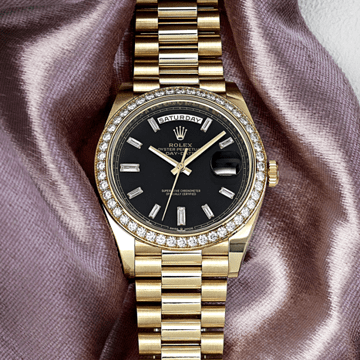
This is the maximal version. Reference 128348RBR is the 36mm Day-Date in yellow gold with a diamond-set bezel, and this configuration adds a diamond-set President bracelet to a fully paved diamond dial carrying baguette-cut rainbow-colored sapphires as its hour markers. Stones run across the bezel, the dial and the bracelet, which means there is no surface on the watch above the case flank that is not set. Rolex offers the same dial with a plain gold bracelet on this reference and with a fluted bezel on the 128238, and the three form a clear escalation. This is the top of it, and it is not a configuration anybody arrives at gradually.
The 36mm case is solid yellow gold, with a bezel set with diamonds in place of the model's usual fluting and a President bracelet whose links are set as well. Setting a bracelet is a considerably harder proposition than setting a bezel, because the links articulate and each stone has to survive repeated flexing without loosening, which is why factory-set bracelets are produced in far smaller numbers than set bezels and why aftermarket work on bracelets fails more often than anywhere else on a watch. The dial is paved across its full surface with diamonds, and the baguette-cut sapphires serving as hour markers are cut as stepped rectangles graduated in color around the circle, returning light in flat planes rather than scattering it. Against white stone on every side, the colored ring is the only element on the watch that is not white, which is what stops the piece reading as an undifferentiated field of light. The day is spelled in full at twelve, the date at three beneath a magnifying lens. The clasp is a concealed folding Crownclasp. A paved field ringed by sapphires sits between a set bezel and a set bracelet here, which makes the colored markers the only element on the whole watch that is not white. Without them the piece would read as a continuous field of light with the day and date apertures as its only interruptions.
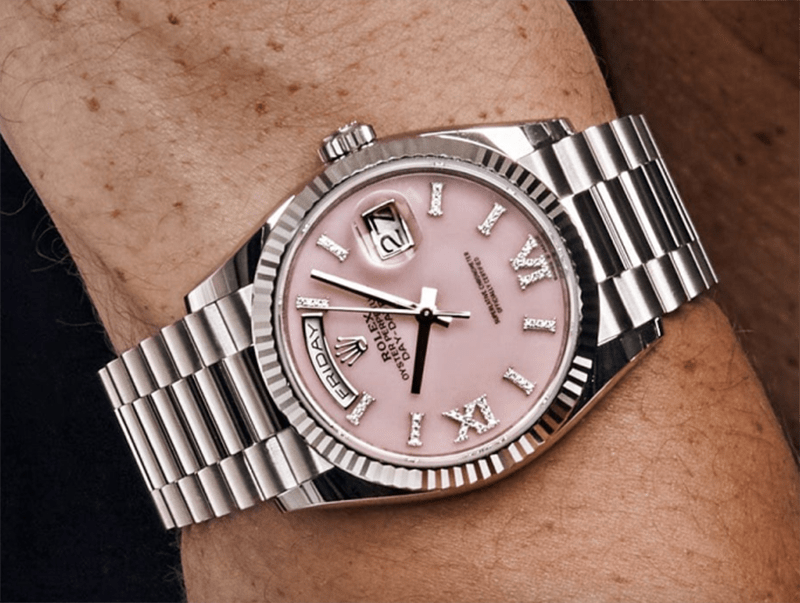
The complication set has not changed since 1956: a day of the week spelled in full, an instantaneous date, secure rapid-setting for both, and a stop-seconds function for setting the time precisely. The Day-Date was the first wristwatch to display the day as a full word, which needed a disc larger than existing calendar architectures could hold, and the movement was built around that rather than adapted from an existing one. Both indications change instantaneously at midnight rather than dragging through the transition. Day discs are offered in a wide range of languages and fixed per watch at manufacture rather than user-selectable. Setting runs through a screw-down crown with a double sealing system; nothing on the case requires a tool. The self-winding movement carries approximately seventy hours of power reserve. It is worth stating plainly that none of this differs from the plainest configuration of the same reference, because gem setting at Rolex adds material to a watch and changes nothing about how it works. Eight grounds are built at this reference and the display never changes beneath any of them. The paved dial is the only one whose markers are sapphires rather than diamonds, and the sapphires are doing structural work rather than decorative work, which is the argument for this dial over an all-white paved one.
Fully set Day-Dates have been in the Rolex catalogue for decades and have always been made in small numbers, constrained by the setting work rather than by demand. The company restricts the practice to precious metals and has never set a steel reference. Within the yellow gold 36mm range this sits at the top of the 128348RBR configurations, above the same reference with a plain bracelet and above the fluted-bezel 128238 carrying the same dial, with the 128398TBR alongside. It belongs to the current 36mm generation, which replaced the 118 series with the present movement family, and sits alongside the 40mm 228348RBR. Rolex does not publish production figures, and configurations at this level of setting are made in numbers far below the plain-dial references. A set bracelet asks more care over a long life than a plain one, since the stones sit in links that flex thousands of times a day and a loosened setting is easier to lose than to notice. Adding stones to the bezel and the bracelet adds metal as well as diamonds, because each seat needs material around it, so the finished watch is heavier than the plain configuration of the same reference. Five of the eight grounds here exist only in set form.
This is bought by collectors for whom discretion was never a consideration and who would regard the plainer configurations as unfinished. It appeals strongly in markets where fully set watches are the norm, and to established buyers who already own several Day-Dates and want the one that occupies a different category rather than a different color. The rainbow sapphire markers are the reason to choose it over an all-white paved configuration, since they give a watch made almost entirely of white stone a single point of color and a reason for the eye to settle. What it does not do is disappear, and the set bracelet is what removes any remaining ambiguity, because a diamond bezel can be read as a factory option while a set bracelet reads as a decision. One further point is worth making, and it concerns how the configuration is best understood. It competes with high jewelry rather than with other watches, and within that comparison it holds an unusual position, because very little else in the category carries a mechanism of this standing beneath the setting. Collectors who evaluate it against a plain gold Day-Date are measuring the wrong thing entirely.