The dark, veined face of this watch was not made in any workshop. It was made in the ground, over a span of time no watchmaker could ever match, because the dial is a thin slice of natural stone: Eisenkiesel, a rare variety of quartz coloured by iron. The name is German, Eisen for iron and Kiesel for flint or pebble, and it describes exactly what the stone is, a quartz shot through with iron oxide that gives it its brooding dark ground and its striking veins of coppery, orange-brown colour that fork across the surface like lightning or like the branching of a river seen from the air. No two slices are ever alike, because no two pieces of the mineral are alike; the pattern on this dial is one the earth drew once, over millions of years, and will never draw again. To wear it is to wear a unique fragment of stone on the wrist, a face no other watch in the world shares.
Turning a mineral into a watch dial is far harder than it sounds, which is part of what makes a stone-dial Rolex so special. A slab of natural quartz has to be sliced astonishingly thin, thin enough to sit as a dial yet somehow still strong enough not to shatter, and stone is brittle and unpredictable, riddled with hidden flaws and fault lines that can crack a slice at any moment during cutting, grinding, and polishing. Many pieces are lost before one survives, and the one that survives must then be drilled for the hands and the date and have its markers applied, all without fracturing. The reward for that painstaking, high-failure work is a dial of a depth and character no paint or lacquer could imitate, a surface with real geological life in it, cool and hard and glossy, every copper vein a flaw turned into beauty. The dark Eisenkiesel ground here, with its metallic veining, is dramatic and moody and utterly natural, a piece of the planet framed in gold.
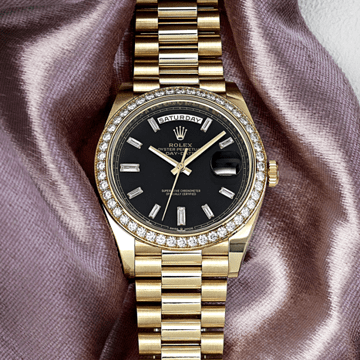
Against that dark stone the watch is lit up with diamonds, and they are placed with real purpose. The hour markers are Roman numerals set with diamonds, the bright figures standing out crisply against the dark mineral and catching the light where the stone absorbs it, so that the time is read off points of fire laid over geology. Around the dial runs a bezel set with a full circle of brilliant diamonds, a glittering ring that frames the dark face and makes it glow darker by contrast. And the diamonds continue onto the bracelet, where the centre links running down the middle of the band are themselves set with stones, so that the sparkle flows from the bezel out along the wrist in an unbroken line. It is a lavish, fully dressed watch, diamonds on the bezel, diamonds for the numerals, diamonds down the bracelet, and yet the dark Eisenkiesel at its heart keeps the whole thing from tipping into mere glitter, grounding all that light in something ancient and natural.
The gold that holds it all is Everose, Rolex's own patented rose-gold alloy, the warm pink metal engineered with a trace of platinum so that its rosy glow is locked in and never fades with age. Its soft, warm colour is the perfect foil for the dark stone and the white diamonds, the three elements, pink gold, dark mineral, and white fire, composing into something rich and harmonious. The case, the diamond bezel, and the bracelet are all of this permanent rose gold, so the warmth will look exactly as it does now for the whole life of the watch.
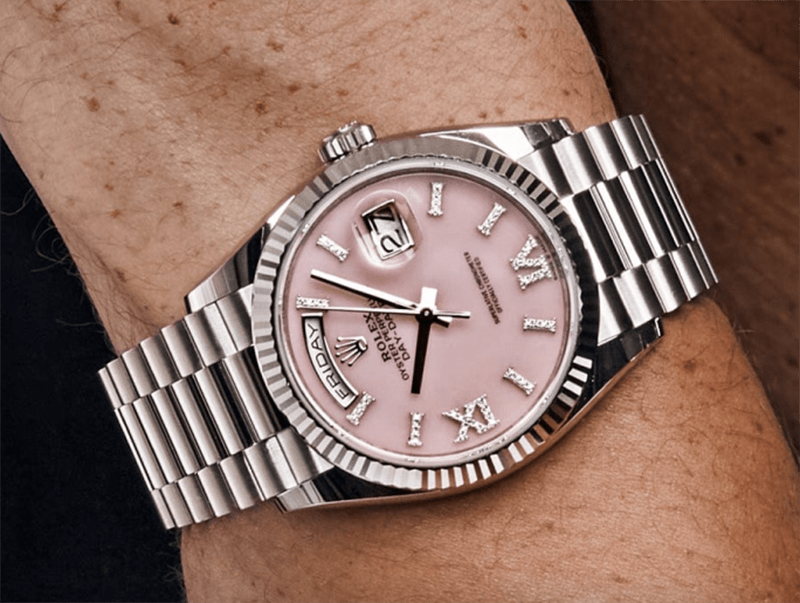
And the watch beneath all this finery is the grandest Rolex makes, the Day-Date. It is the model that in 1956 became the first wristwatch to show the day of the week spelled out in full, in the arched window at the top of the dial, as well as the date at three, and it has been the summit of the Rolex range ever since, made only ever in precious metal and worn on the bracelet Rolex named the President for its association with leaders and heads of state. This is the thirty-six-millimetre size, the original and classic proportion of the model, elegant and balanced on the wrist. Beneath the stone dial sits Rolex's current-generation self-winding movement, certified to the brand's Superlative Chronometer standard, with the robustness and accuracy that define a modern Rolex, so that for all its jewels and its slice of ancient quartz, it keeps excellent time and is built to run for generations.
That is what makes this Eisenkiesel Day-Date so special. It takes the most prestigious watch Rolex builds and gives it a dial that is a unique fragment of natural iron-bearing quartz, formed in the earth over unimaginable time and found on no other watch, then frames that dark, copper-veined stone with diamond Roman numerals, a diamond bezel, and a diamond-set bracelet, all in warm, permanent Everose gold. It is a meeting of the geological and the jewelled, something the planet made and something the jeweller made, fused into one object, and it carries that rare marriage with all the quiet authority of the watch of presidents.