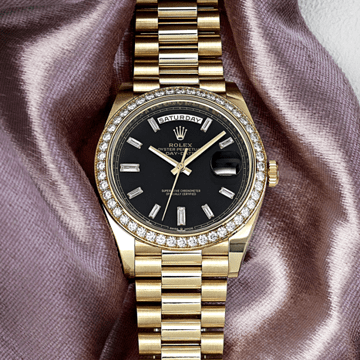
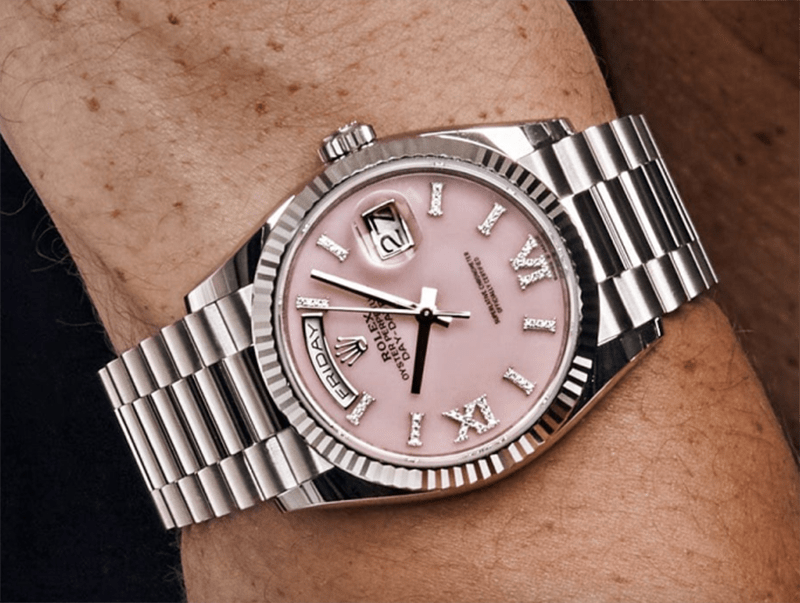
Roman numerals on a gem-set chocolate dial is the one arrangement here that carries both kinds of ornament at once. Reference 278285RBR is the 31mm Datejust in solid Everose gold with a bezel set with diamonds, and this configuration carries a chocolate dial set with diamonds and applied Roman numerals, on the President bracelet. Most gem-set dials replace the marker set with stones, and this one keeps the numerals and adds the stones alongside them, which gives the dial both a sequence to read and a scattering of light across it rather than choosing between the two. Chocolate has only ever been built on the Everose cases, which keeps this combination confined to a single metal.
That combination puts more on a 31mm dial than any other configuration on the reference, and the proportions are what stop it becoming crowded. Rolex draws the numerals for each case size rather than scaling a single set across the range, so those fitted here are sized for this dial rather than inherited from a larger one, and a full Roman sequence already occupies a considerable share of the surface before anything is set into it. The chocolate lacquer is applied in several thin coats to keep the tone even across a curved surface, opaque and holding one value regardless of angle, dark enough that the diamonds read considerably brighter than they would on a pale ground. Chocolate exists because Everose does, developed after the alloy arrived and specifically to accompany it, which is why it appears on the Everose references and almost nowhere else. The case is solid Everose rather than a two-metal combination, uniform from the lugs through the bracelet and considerably denser than steel, so the watch carries noticeably more mass than its size suggests. Everose is Rolex's own rose gold, cast in the brand's foundry and introduced in 2005, with a small proportion of platinum that stops the color drifting toward yellow across decades, which matters on a dial drawn to sit one step darker than its own case. The bezel stones are seated individually into recesses cut in the gold rather than dropped into a preformed channel. The bracelet is the President, semi-circular three-piece links with a concealed clasp folded away so completely that the bracelet appears continuous from every angle, tapering from the lugs toward the clasp so the mass sits forward on the wrist.
The date is the only indication the watch carries beyond the time, and a single aperture is what allows a full Roman sequence to fit at all, since a second window would leave no room for twelve numerals on a dial already carrying stones. Rolex matches the date disc to the dial rather than leaving a paler window in a darker surface. The Cyclops lens above it has been part of the model since 1953 and magnifies the date roughly two and a half times, which makes a small window readable without enlarging it and unbalancing the dial. The date changes instantaneously at midnight rather than creeping through the surrounding hour, the feature the Datejust introduced in 1945 and the one it takes its name from. Correction runs through the winding crown without moving the hands, and nothing the watch asks for requires a tool. The movement is self-winding with a power reserve of approximately 55 hours, an engineering result on a movement built to fit a 31mm case rather than a figure carried down the range, since a smaller barrel has less room to store energy and a proportionally smaller rotor gathers less of it. The rotor winds in both directions rather than only one. The crown screws down against the case. Correction takes seconds and requires no tool, which on a bracelet of this weight matters more than it would on a lighter one.
The Datejust arrived in 1945 as the first self-winding wristwatch to show the date in a window, and the 31mm case sits between the 28mm Lady-Datejust and the 36mm original, which makes it the size for buyers who find one too small and the other too large. The 278000 generation replaced the 178000 series in 2018 with a revised case and bracelet. Roman numerals have been offered across most of the model's history and have never been the volume choice. Everose arrived in 2005 and has become the metal most closely associated with the model. Solid gold references are built in far smaller numbers than the steel and two-metal ones. The President bracelet was designed in 1956 for the Day-Date and appears on the precious metal Datejust references as a borrowing rather than an inheritance. Within the generation, 278285RBR is the solid Everose reference with a diamond-set bezel. Chocolate has also never been offered on a steel reference, only on the Everose cases, which makes it one of the few dial colors in the range that cannot be had in any other metal. Chocolate is the only ground at this reference offered in two marker arrangements, the large Roman six here and a full ring of diamond hour markers, and it is one of four grounds that appear in set form alone.
The buyer for this is not choosing between structure and decoration and has decided not to. That refusal is uncommon, since most dials in the range make the buyer pick one or the other, and the result is a watch that reads as considered from the numerals and as ornamental from the stones without either quality cancelling the other. It also asks more of a viewer than any other dial on the reference, since there is a sequence to follow and a scattering to notice and the two operate at different distances. Buyers who find the plain gem-set dials insufficiently structured and the plain Roman dials insufficiently decorated arrive here having already rejected both. It is the fullest dial the reference offers and the one that takes longest to finish reading. Three grounds at this reference take the large Roman six, chocolate among them with aubergine and slate, and the diamond hour markers appear on four dials here, chocolate included. Only the President bracelet is offered.