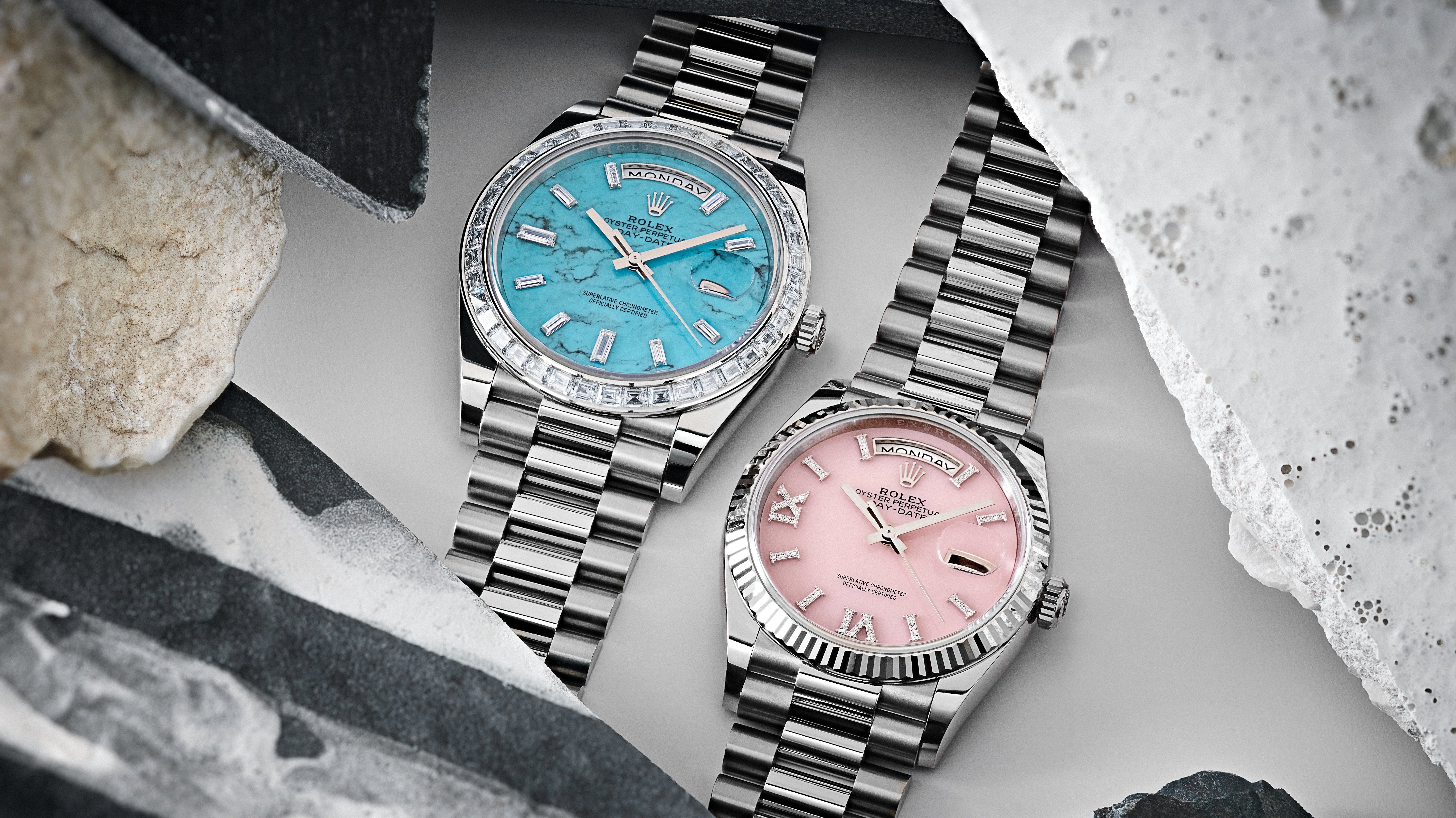
Watches with stone dials have been around since the 1960s, but they have experienced a massive resurgence in popularity over the course of the last several years. Since the faces of stone dial watches are made from actual slices of semi-precious stones, no two dials will ever be completely identical, and today’s collectors arguably have more options than ever before. In this article, we’re breaking everything you need to know about stone dial watches, including their history, how they’re made, which brands still produce them, and (most importantly), how much it costs to add one to your collection.
The History of Stone Dials

Within the greater context of watchmaking, stone dials are a relatively new development, as the first examples didn’t appear until the early/mid 1960s. The famous luxury watch/jewelry brand Piaget is often credited with producing the first commercially available wristwatches with stone dials in 1963; however, it was Rolex that truly popularized the concept throughout the following with a vast assortment of different stone dials that were available for the Datejust and Day-Date.
A number of brands continued to produce stone dial watches into the 1980s, but by this point in time, the advent of quartz timekeeping had forced much of the Swiss watch industry into survival mode. Rather than creating high-end mechanical watches with semi-precious stone dials, brands shifted their focus towards competing with low-cost timepieces from Asia. As consumer trends started to favor larger sizes and sportier designs throughout the 1990s and early 2000s, stone dials became increasingly less common, and while the watch industry itself had stabilized after the Quartz Crisis, stone dials no longer fit the aesthetic ethos of the era.
Over the course of the last decade, interest in vintage watches has brought the spotlight back to stone dials, and as collectors discover the vast assortment of different stones that once graced their favorite Rolex models, significant demand grows for modern stone dial watches. Additionally, buyers are starting to favor smaller case sizes and dressier designs, and this shift in consumer preferences perfectly aligns with the modern revival of stone dials. Today, there are more stone dial watches than ever before, and many of the big-name luxury manufacturers now produce select models with semi-precious stone dials.
About Stone Dial Watches

Unlike traditional watch dials that use lacquer, enamel, or engravings to achieve their desired appearance, the surface of a stone dial is formed by a thin slice of semi-precious stone, and its appearance is entirely dictated by that particular slice of the material. Some brands will add hour markers or printing on top of the stone’s surface, but the entire concept of a stone dial is to showcase the natural beauty of the material, and the artisans who create these dials go to great lengths to select pieces of stone that will be aesthetically pleasing as the face of a watch.
The allure of stone dials is easy to understand, as they can appeal to collectors on multiple different levels. Given that each stone dial showcases a different pattern throughout its surface, no two examples will ever be entirely identical — even when cut from the exact same piece of stone. Similarly, the level of skill and craftsmanship that is required to create a stone dial perfectly plays into the foundational values of high-end watchmaking, and many collectors enjoy the thematic juxtaposition of having a naturally occurring material inside a distinctly man-made object that is emblematic of human ingenuity.
How Are Stone Dials Made?

The majority of stone watch dials are created by attaching a thin slice of semi-precious stone to a metal base layer that serves as the foundation, with the stone essentially taking the place of the lacquer or enamel that would otherwise be applied to the surface of a traditional dial. In order to fit between the movement and the hands, the stone needs to be incredibly thin, but shaping it to the required dimensions is a highly delicate process, and a significant number of stone dials get scrapped long before they ever have the chance to be installed inside a watch.
Many stone dials require their layers to be less than a millimeter thick, and since stone is a natural material, shaping it comes with an inherent degree of variability. Some types of stone are simply easier to carve than others, and even two pieces of the same type will have slightly different compositions throughout their structures. Creating an ultra-thin disc is already rather difficult, but the apertures for the hands and calendar windows also need to be cut into the stone, and if the dial features applied logos or hour markers, then each of their individual connection points requires a separate hole to be drilled through the wafer-thin stone disc.
After achieving its desired shape, the upper surface of the stone is polished to reveal the material’s natural structure, and the polished slice of stone will then serve as the background for the rest of the dial. Printing and text is applied directly onto the stone, and the hour markers are attached with tiny connecting pins that extend through holes in the stone layer and secure to the metal base layer on the opposite side of the dial. If any part of the stone develops a chip or crack, the entire process must be restarted, and certain stones like opal are notoriously fragile and difficult to shape into dials.
Watch Brands That Offer Stone Dials
 Many of the biggest names in the luxury watch industry have released models with stone dials over the course of the last few years, although it's important to note that stone dials are typically reserved for premium models. As you would expect, brands that equally specialize in watches and jewelry like Cartier, Bulgari, Piaget, and Chopard all produce select models with stone dials, and the Bulgari Serpenti Spiga ref. 103626 expands upon an already luxurious gem-set design by pairing it with a vibrant green malachite dial.
In more recent years, established Swiss independent brands like MB&F and H. Moser & Cie have also released models with artfully crafted stone dials, but this growing trend isn’t limited to the high-end segment of the market, and mainstream luxury brands like Omega also offer a wide variety of different watches that showcase dials made from semi-precious stones. Additionally, some brands like A. Lange & Söhne and Jacob & Co. have been known to incorporate stone dials in a less obvious manner, and the Jacob & Co. “The Casino Tourbillon” uses black onyx stone instead of lacquer or enamel on its dial.
With that in mind, Rolex and Audemars Piguet are easily the two luxury brands that are most famous for stone dials in the modern era. Rolex has a rich history of producing watches with stone dials, but after shying away from the concept for a few decades, the Swiss manufacturer has been reinstating stone dials and even expanding its offerings to include popular sports watch models like the Daytona, GMT-Master II, and Yacht-Master. Similarly, Audemars Piguet has also been ramping up its stone dial offerings in recent years with multiple different models from its Code 11.59 and Royal Oak collections, and to celebrate its 150th anniversary last year in 2025, Audemars Piguet released the Code 11.59 Grande Sonnerie Carillon Supersonnerie ref. 26397OR.OO.D417CR.01, which features a dial crafted from Harlequin opal.
How Much Do Stone Watch Dials Cost?

The price of stone dials can range greatly depending on the type of watch and the design of the dial itself. Additionally, the retail premiums attached to stone dial watches can often differ dramatically from the values that exist on the secondary market, and certain rare models are worth significantly more than their original retail prices, simply because only a handful of examples were fitted with that particular dial. Similarly, the type of stone can also influence prices, and two identical watches that are fitted with the exact same style of dial can ultimately be worth different values on the open market, solely because one stone displays a more appealing pattern than the other.
Rolex currently offers a tiger’s iron stone dial for the 18k yellow gold GMT-Master II ref. 126718GRNR, and the model is priced at $48,400 when equipped with a standard black dial and $52,800 when fitted with a tiger’s iron dial, which results in an additional retail premium of $4,400. However, on the secondary market, the standard version of the Rolex GMT-Master II 126718GRNR sells for roughly $50,000, and its tiger’s iron sibling trades hands for nearly $100,000, which represents a significantly higher premium than what exists at a retail level.
Meanwhile, the 18k Everose gold Rolex Day-Date 40 ref. 228235 has an official retail price of $51,600 when it is fitted with a standard dial and $56,350 when equipped with a dial that has baguette-cut diamond hour markers. However, when that same model is furnished with an eisenkeisel stone dial that also has baguette diamond indexes, Rolex charges $62,700, and this works out to an additional premium of $4,750 for baguette-cut diamonds, and a further premium of $6,350 for the eisenkeisel dial. On the secondary market, the eisenkeisel version of the Rolex Day-Date 40 228235 sells for just shy of $70,000, which is a further increase above its retail price, but a much less dramatic premium than the tiger’s iron GMT-Master II.

As for how the type of stone can influence both retail and open-market prices, the 18k yellow gold Rolex Day-Date 36 ref. 128398TBR costs $99,650 when it is fitted with a carnelian dial and $101,100 when fitted with a turquoise dial. Aside from the type of stone that is used in their construction, the two dials are otherwise completely identical, and this results in an additional retail premium of $1,450 for a dial that is made from turquoise instead of carnelian. On the secondary market, both stone dial versions of the Day-Date 36 ref. 128398TBR trade hands for values north of six figures, with the carnelian dial version priced around $130,000 and prices for its turquoise sibling hovering around $145,000.
When it comes to Audemars Piguet’s stone dial watches, the open-market premiums attached to them are typically quite a bit higher than what you will find among Rolex’s catalog. As a point of reference, the 37mm Audemars Piguet Royal Oak Selfwinding ref. 15550BA.OO.1356BA.01 in 18k yellow gold with a turquoise dial has an official retail price of $75,700, but that same watch sells on the open-market for a staggering $185,000, which represents a six-figure premium above its original retail price. A similar statement applies to other Royal Oak models with semi-precious stone dials, and it is not uncommon to see these watches selling for tens or even hundreds of thousands of dollars above their standard-dial counterparts.
Popular Types of Stone Dials

In theory, virtually any type of stone can be turned into a watch dial, and Rolex alone has featured more than a hundred different semi-precious stones (and stone-adjacent materials) on the dials of its watches. In more recent years, brands have started showcasing less conventional stones; however, some types of stone are simply better suited for watch dials than others, and there are a handful of semi-precious stones that tend to be favored by the modern luxury watch industry.
Among all the different types of stone that are featured in modern watch dials, turquoise easily ranks among the most popular, and the stone is characterized by a striking pale blue appearance with natural striations running throughout its structure. Since turquoise offers a hue that is similar to popular shades like Tiffany Blue and ice blue, some brands use turquoise to create an elevated version of these trendy aesthetics. For example, rather than being fitted with an ice blue dial (which is a color exclusively reserved for Rolex’s platinum models), the Rolex Day-Date 40 ref. 228396TBR is fitted with a striking turquoise stone dial, and it can sell for well over half a million dollars on the open market.
Onyx is another type of stone that is frequently used for watch dials, and it provides a glossy appearance that almost resembles black-colored glass. Some brands use onyx in place of black lacquer or enamel, and the onyx dials fitted to vintage Rolex watches simply look like gloss black dials that are missing hour markers and a minute track. However, in the modern era, Rolex chooses to showcase the natural asymmetries of the stone, and the onyx dials fitted to the 18k yellow gold Day-Date 40 ref. 228238 frequently feature a single pale line running horizontally across their surfaces.

For green-colored stone dials, malachite is often the go-to choice for today’s luxury watch brands, and the structure of the stone consists of large wavy lines in varying shades of green. Audemars Piguet offers the 18k yellow gold Royal Oak with a malachite stone dial in both 37mm and 41mm formats, and it is also rather common to find vintage Rolex Lady Datejust watches that are fitted with dials made from malachite. With that in mind, certain modern watches like the 18k yellow gold Day-Date 36 ref. 128238 are also fitted with malachite stone dials, and these models provide a striking and luxurious expression of Rolex’s signature color.
During the original heyday of stone dials in the 1970s, tiger’s eye was a highly popular option, and the stone features a vibrant golden brown color with distinctly striped composition. Vintage Rolex Datejust and Day-Date models can often be found with tiger’s eye dials, although the brand has moved away from using this type of stone in recent years, and models like the yellow gold GMT-Master II ref. 126718GRNR and Everose gold GMT-Master II ref. 126715CHNR are now offered with tiger’s iron dials, which have a darker and more complex aesthetic than their tiger’s eye counterparts.
While turquoise serves as the go-to stone for light blue hues, lapis lazuli is the preferred option for darker shades, and this semi-precious stone features a deep blue color with small flakes of golden pyrite and white calcite embedded in its structure. Lapis dials are most frequently found on vintage dress watches, and you will find examples from a variety of big-name brands, including Patek Philippe, Audemars Piguet, and Piaget. With that in mind, a number of older Rolex models can be found with dials made from lapis lazuli, and in addition to being an option for the Datejust and Day-Date, Rolex also produced a very small number of solid gold Submariner and Daytona watches that were fitted with lapis stone dials.